


Today I drove to Birmingham, AL, walked up the steps of the Hugo L. Black United States Courthouse, and hand-delivered a Motion to Remand — one more step in a fight that, more and more, feels less like one woman against a corporation, and more like standing united with everyone else who’s ever felt a big company try to bully them into backing down.
There’s something different about doing it this way. It’s easy to forget that at some point, paperwork has to physically land in a physical building, in front of a physical clerk, under a name carved into stone. Standing in front of that building today, I felt the weight of that a little more than usual — and I won’t pretend the name on the front of the courthouse didn’t give me pause. Some names carry more history than others. I’ll leave it there.
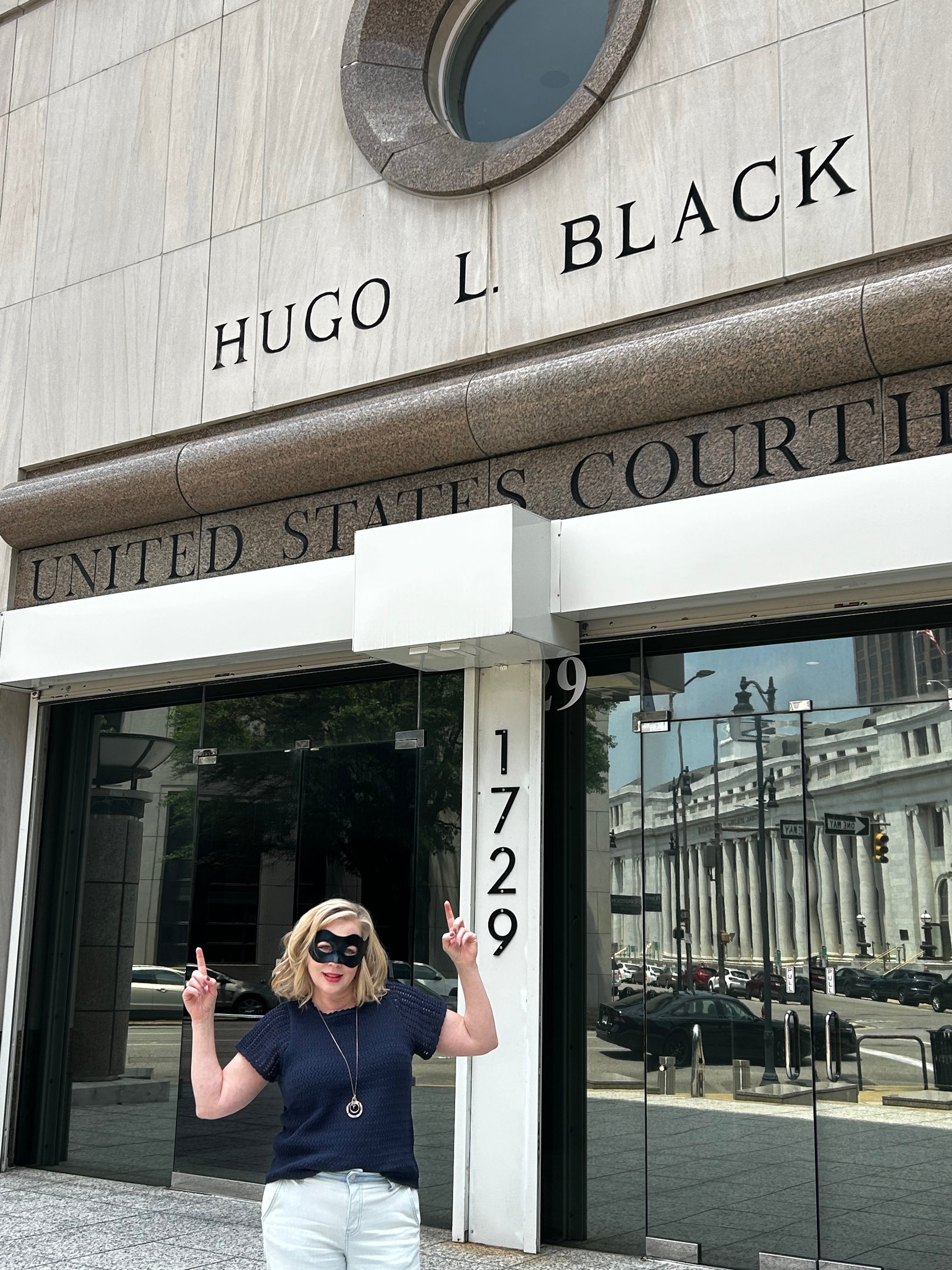
Why I Filed In Person
This one had to be hand-delivered.
There’s a certain peace of mind in watching a clerk stamp a document with your own eyes — but beyond that, there was something almost fitting about it. Federal courthouses aren’t built to be forgettable. The architecture, the security line, the hush of the hallways — it’s a reminder that this is real, moving through a real system, one filing at a time.
The Quotes on the Wall
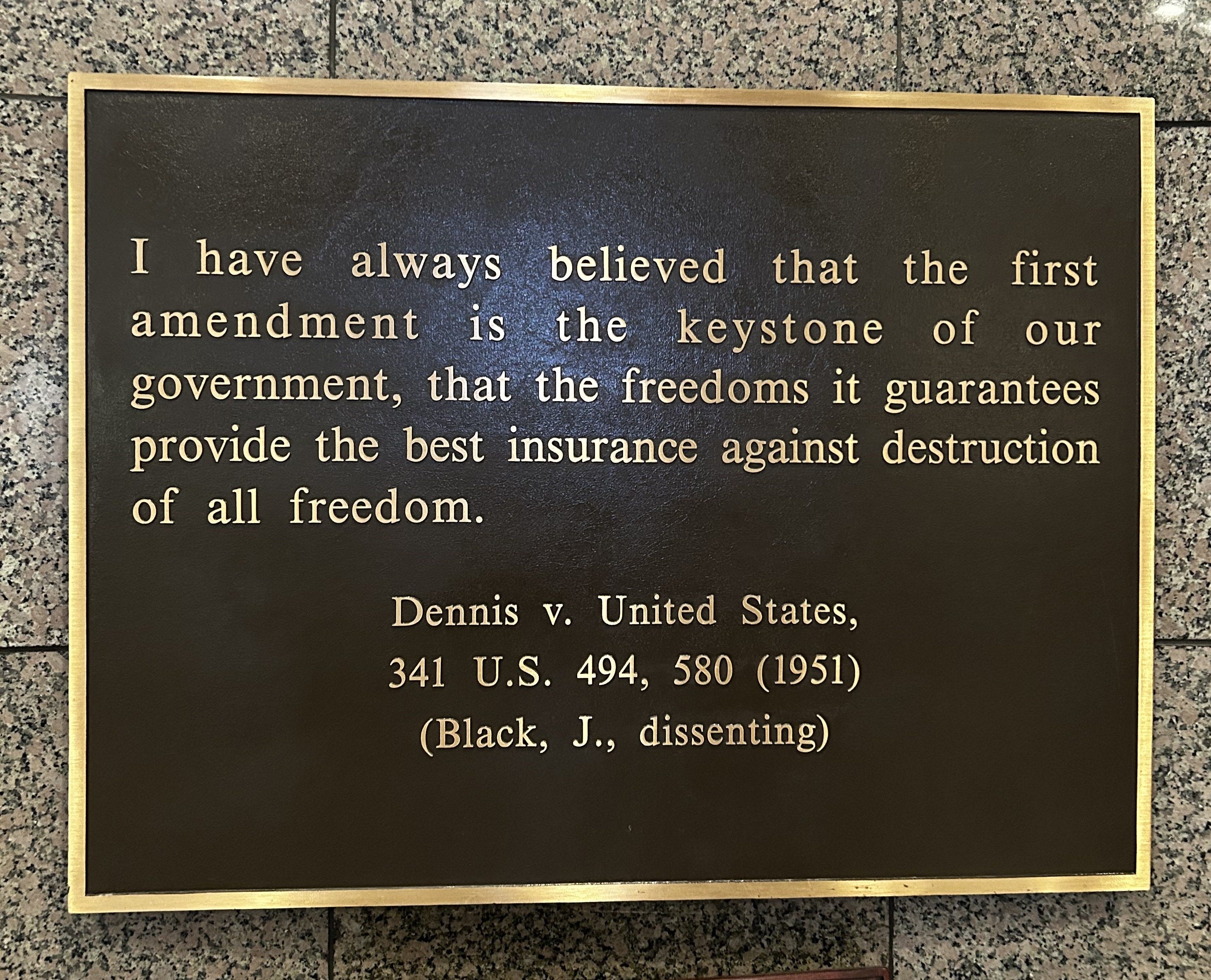
While I was there, I stopped in front of two quotes posted inside the courthouse — words attributed to Hugo Black himself, on the subject he was arguably most famous for defending: the First Amendment.
Black spent 34 years on the Supreme Court, and the two quotes posted in that lobby capture both sides of the man — the personal devotion and the judicial philosophy.
The first, from a 1968 lecture, gets at how he felt about the Constitution on a personal level:
“The constitution is my legal bible; its plan of our government is my plan and its destiny my destiny. I cherish every word of it, from the first to the last, and I personally deplore even the slightest deviation from its least important commands.” — Carpentier Lectures, delivered at Columbia University Law School, New York, NY, March 1968
The second is from one of his opinions on the bench, and it’s the one that stopped me longest:
“Under our constitutional system, courts stand against any winds that blow as havens of refuge for those who might otherwise suffer because they are helpless, weak, outnumbered or because they are non-conforming victims of prejudice and public excitement.” — Chambers v. State of Florida, 309 U.S. 227, 241 (1940)
That’s a bold, almost stubborn, reading of the Constitution — and it’s not a bad thing to be reminded of, whatever brings you through those doors. Words carved into a wall have a way of landing differently when you’re standing there in person, about to hand a stack of paper across a counter, than they do in a textbook or a law school lecture.
What That Has to Do With Why I Was There
I litigate some of my own TCPA cases pro se — no attorney standing between me and the courtroom, just me, the filings, and the record. And along the way, I’ve been told, more than once, that I shouldn’t be writing publicly about cases that are already a matter of public record. That my blog, this investigation, my own documented account of what’s happening in cases I am a named party to — that somehow that’s off-limits.
Standing in that lobby, reading Black’s words, that idea didn’t hold up.
Court filings are public. Docket entries are public. What I file, what gets ruled on, what gets argued — none of that is a secret, and none of it stops being a matter of public record just because a company would rather protect its reputation. Or would rather other people not find out what happened to me and realize they can sue them for the exact same thing. Black spent his career insisting that “no law” means no law — that the First Amendment doesn’t come with an asterisk for whoever finds the speech inconvenient. I’m not a party to be talked over. I’m pro se. This is my case, my record, and my right to write about it.
And that second quote — about courts standing as “havens of refuge” for the “helpless, weak, outnumbered” — is the part that actually explains why I keep doing this in the first place. Because here’s what I’ve actually lived through: I’ve told this company to stop calling. Not once, not twice — I’ve sued over it three separate times before this case. And instead of stopping, what I’ve experienced feels less like a company correcting course and more like being bullied — big, well-funded, and banking on the idea that if they wait me out, threaten, and make it expensive and exhausting enough, I’ll eventually just go away. But it hasn’t worked, and it isn’t going to.
That’s exactly the kind of imbalance courts are supposed to exist to correct — one person, standing alone in a marble lobby, against an operation with more lawyers than she has hours in the day. But “alone” is doing a lot of work in that sentence, because it isn’t really true. Every consumer who’s been ignored after saying “stop calling me.” Every person who’s felt the weight of a company with far more resources trying to make them feel small enough to quit. Every pro se litigant who’s shown up to a courthouse without a law firm behind them — we’re not alone in this. We’re UNITED. And no amount of pressure changes the fact that the law is supposed to apply to everyone, corporations included, whether or not they can afford to pretend otherwise.
I didn’t expect a courthouse lobby to reframe why I do this work. But it did, a little. I walked in to file paperwork. I walked out reminded that this fight was never really about one company versus one person — it’s about whether the law means what it says for everyone, or just for whoever can afford the best lawyers. UNITED is what happens when enough people get sick and tired of companies thinking they're above the law.
What’s Next
The motion is filed and now in the court’s hands. There’s more coming on this case — and as always, everything I write about is public record. I’d rather you go look it up and see it for yourself than just take my word for it. Because that’s the only way that these harassing phone calls will end… if we stand UNITED.
Thanks for following along. More soon.